Disha Bangladesh

Making sense of Bangladesh. Disha will scan the cream of truth from the sea of muddy-misinformation.

Google Groups Subscribe to Disha Bangladesh
Email:

Monday, January 01, 2007

Awami League in cynical pact with Islamic 'militants' with links to terrorism

In the last two weeks, the Awami League has entered into an electoral alliance with people they have previously described as 'extremists' and parties with open sympaties with the Taliban.

For years we have been made aware of the existence of Al-Qaeda-type terrorism in Bangladesh. Bombs have gone off throughout the country and leading figures have been assassinated. The culprits, the small and insignificant JMB, have been caught. Yet, the Awami League has happily pushed the mantra that we are witnessing the 'talibanisation of Bangladesh'.

We have been subject to an emerging international discourse telling us that the problem is endemic. Mediocre analysts and gullible international activists have happily consumed Awami League propaganda dictating that: Bangladesh is an avowedly secular state, parties that draw from the country's rich religious (and syncretic) history are unpatriotic. Religiously inspired parties have explicit links to terrorism and are responsible for the country becoming another Afghanistan.

The Awami League has formulated this template as an appropriate weapon to defeat its opponent. Thus the ruling Bangladesh National Party has been accused of entertaining extremists in the form of the Jamaat-e-Islami, a moderate constitutional party believing in multi-party democracy. The AL has then proceeded to pin every act of violence and every cliché of Islamism that exists in our post 9/11 world on the Jamaat-e-Islami. As this blog has outlined earlier, lazy and unscrupulous journalists and academics have willingly taken up this narrative with gusto.

The trouble is, that narrative is unravelling before our very eyes. The Awami League is in meltdown as the leadership cynically enters into an electoral pact with people and parties they previously described as militant Islamist. On 27 December, the AL-supporting Daily Star reported that the Awami League has nominated 'militant leaders' to be part of their electoral alliance. Two are noteworthy of mention, Habibur Rahman of Syhlet (locally known as Bulbuli Huzur) and Mufti Shahidul Islam, a veteran of the Afghan war. Habibur Rahman is linked to Harkat-ul Jihad al-Islami (Huji), an organization banned by the government in 2005 for being a self-proclaimed terrorist organisation. In 1989 he was a guest of the Harkat-ul Jihad Pakistan (a USA banned organisation) where he surveyed the frontline in Afghanistan. Shahidul Islam was once accused by the Awami League leader herself, in the Bangladesh Parliament, for harbouring militant connections.

As if things couldn't get ironic and surreal enough, the League has now entered into an electoral pact with the Khelafat Majlis and has agreed to a five-point memorandum of understanding, which includes a pledge not to enact laws in contravention to Qur’anic values, sunnah and shariah. The guardians of these values will be a small-band of narrow-minded ‘hakkani-alems’: no reference is made to the plurality of jurisprudence and thought in Islam. To some, the League's choice of partners make the Jamaat-e-islami (whom they oppose) cuddly centrists.

'Secularists' are in free-fall. Many cannot fathom the party's about turn. Mahfuz Anam, editor of the AL-supporting Daily Star has penned his state of puzzlement in a strong editorial. Lord Avebury, rent-a-gob for the Awami League is now questioning his godfathers. All demand to know: what happened to that secular Bangladesh we were sold? The answer is, it never existed. But nor did there exist a Pakistan-type society that others are cautioning against. This, of course, requires deliberation – one that examines Bangladesh’s past, and not the Stalinist re-writing of history in the past 40 years.

As we reported earlier, Martin Bright, political editor of the New Statesman, claimed at a Policy Exchange event that people of his profession are pig-ignorant about Bangladeshi politics. We have demonstrated his persistence in keeping the status quo as he sups with the Awami League. In a subsequent blog, Bright pleaded:

“In this sense, every Bangladeshi election is a fight for the country's soul. On the one side stand those who believe in an essentially secular Bengali identity; on the other are those who want the country defined as a Muslim state, much as Pakistan is.”


Mr Bright is completely uninformed about Bangladesh’s secular and religious identity. As his party of choice (the Awami League) proceeds to debunk his maxim, he is right about one thing, the forthcoming election will be a fight for Bangladesh’s soul. But the contest will be between the people of Bangladesh on the one hand, and a corrupt political-criminal mafia like elite who will use any means (subterfuge, lies and violence) to get into power.

Labels: ,

Sunday, December 24, 2006

Dynamiting Democracy in Bangladesh

The Awami League reigns free to pursue a reign of terror to intimidate the Bangladeshi electorate. It has successfully diverted international attention away from itself as it lights the fuse to dynamite democracy in Bangladesh

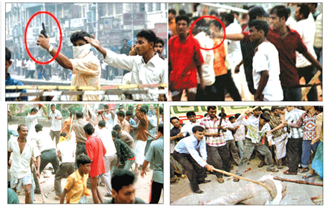
The opposition fourteen-party alliance led by Sheikh Hasina of the Awami League is engaged daily in a deadly game of destabilising the infant democratic process of the country. The last onslaught of their escalating spiral of violence went far beyond the depth to which even the Awami League is expected to stoop; this time it did not hesitate to violate the sanctity of the country’s highest court of justice – the Supreme Court. The Chief Justice’s chamber was totally ransacked and set on fire by the Awami hoodlums. This happens within weeks of these terrorist lynch mobs systematically clubbing to death, on 28 October 06, a number of innocent and unarmed supporters of other political groups in Dhaka in broad day light and in the full view of television cameras watched by millions around the world. In the words of Amnesty International, we are witnessing a ‘wave of violence that has engulfed Bangladesh over last five days’ (reported on 01.11.06), ‘over thirty people were killed and hundreds others have been injured’. The ferocity of the murderous terrorism is further underlined by the vicious arms the murderers used and the way they danced on the dead after committing the murders. In some cases they even used pistols and other firearms. The deafening silence from Awami League leader Sheikh Hasina or any one from the Awami League High Command was palpable. The lack of condemnation smacks of complicity.

See the AL orchestrated violence below


But where is the debate? Where is the outrage? Our previous post reported the success the Awami League has had in lobbying the international community and deflecting any scrutiny towards their murderous tactics. It seems to have paid off. International discourse, and pronouncements from international groups seem to have bought Awami League misinformation hook, line and sinker. When it come to Bangladesh then, analysis is not subject to the rigors of customary tests and analysis. Even the foremost humanitarian organisation Amnesty International could not bring itself to take the perpetrators to task and five days after the gruesome lynching merely issued a press statement ‘strongly’ condemning ‘the wave of violence’ and asking ‘the political parties’ to condemn and refrain, bracketing both the murderers and the victims in the same category. But shying away from naming names is not Amnesty’s normal practice. On the same day that Amnesty International issued its statement, this correspondent notes how Amnesty is happy to be more forthright on non-Bangladeshi matters: ‘to Act Now for Bitondo Nyumba who has been beaten and raped by government soldiers from her own country.’

Meanwhile, New York-based Human Rights Watch betrayed its claims to be impartial by, on the one hand, remaining silent on Awami League excesses, but on the other hand, (rightly) cautioning the government and former ruling party over the possible use of security forces to further its own objectives. Lacking fair language, and shedding any rigorous intellectual inquiry, HRW forgot to mention that the military has studiously strayed away from politics since 1991, and that, given the cycle of violence unleashed by the Awami League, security forces were deployed to maintain law and order. If Human Rights Watch were to look at this objectively, it would also report on the private armies maintained by all political parties, most notably by the Awami League through its ‘Chatra’ and ‘Jubo’ League.

Bangladeshis know Awami League is responsible
Bangladeshis however do not in the slightest doubt the identity of the real culprit. In a survey carried out by the interactive current affairs bulletin ‘Bangladesh Pratidin’ (Bangladesh daily) of the London based Bangla TV 61.82% said they consider the Awami League is responsible, 34.43% thought it was the BNP, while just 3.59% blamed the Jamaat for this violence. It should be noted that Bangla TV is no friend of the BNP or the Jamaat.

A sinister onslaught against the Centre-Right and Islamists in Bangladesh is now gathering pace in earnest. Cognisant that it is unlikely to challenge the success of the BNP through democratic norms, the party is deploying unmitigated violence to intimidate the Bangladeshi electorate. Internationally, the Awami League is playing a clever game to deflect attention away from it, but at the same time clipping the wings of law enforcement agencies who can check that violence. The Awami League has powerful friends abroad, and is succeeding to stifle international scrutiny.

Sheikh Hasina and her international mentors are increasingly frustrated to see the success of the four party centre-right alliance composed of mainly nationalist Bangladesh National Party (BNP) of the outgoing prime minister Begum Khaleda Zia, the Jamaat-e-Islami (JI) led by Motiur Rahman Nizami, smaller Islamic group the Islamic Oyko Jote and, lately, the Jatiyo Party of former President Ershad. The Jamaat had two cabinet posts occupied by the leader of the party Mawlana Nizami and its secretary-general Ali Ahsan Mohammad Mujahid. Both received national and international accolade for being competent and incorrupt. Over the last five years, the BNP has managed to lead a plural government, and has presided over steady economic growth. And, as its term ended, the Government resigned and fully subscribed to the possibility of democratic transition.

Political violence, especially during election campaign has become an essential part of the electoral process. This, coupled with wide spread fraud and ballot rigging makes a mockery of the democratic process. Consequently on the Jamaat’s proposal a new system of Care Taker Government (in 1995) is now been enshrined in the constitution of the country requiring the sitting government to retire at the end of their term when a neutral Care Taker Government headed by the most immediate retired Chief Justice of the Supreme Court takes over. The head of the government during this period takes the title of Chief Advisor and not the Prime Minister. The Chief Advisor appoints non-political technocrats to take charge of different government departments and hold election within three months of taking office.

In order to have a free hand in election manipulation Sheikh Hasina and her Awami League party are determined to see their party nominees in different important positions and leave no stone unturned to achieve this objective. Since Begum Khaleda Zia handed over power at the end of her five year term to the President on 27th October, the Awami League refused to accept the newly appointed Chief Advisor, The Chief Election Commissioner and even insisting for the resignation of the elected President and all senior Civil Servants. Unlikely to achieve its unconstitutional and undemocratic demands, the League began its ferocious hooliganism on the 28th October 06.

Sadly, it seems the Awami League enjoys the full support of foreign governments. Western ambassadors and visiting government leaders apply pressure on the President to give-in to unreasonable Awami diktats. It is also reported that they met some of the senior appointees and tried to persuade them to give up their positions to satisfy Awami demands. And every leverage has been used to intimidate these elected officials of a sovereign government. From the withholding of investments to the mobilisation of foreign pressure groups.

Many Bangladeshis cannot help think they have been here before. A proud Muslim country is seeking to determine its destiny by fusing modernity with a polity inspired by its rich linguistic and Islamic heritage. Foreign powers cannot stomach this, and deploy every means to stop this. Plassey anyone? Bangladesh is not Afghanistan, and the Jamaat is not the Taliban. But that is how it is being painted, and, it seems, this is why the Awami League is being allowed to subvert democracy.

For instance a report compiled for the U.S Congress entitled ‘Bangladesh: Background and U.S Relations’ was published on 7th September 2006. The report bears the name of Bruce Vaugan, Analyst in South East and South Asian Affairs, but its content is littered with evidence that it could have been penned by Awami spin doctors. The report’s anti-Bangladeshi, pro-Awami and pro-India bias is glaringly obvious. Criticising Richard Boucher the Assistant Under Secretary of State for South and Central Asian Affairs for his soft line to the Bangladesh government the report detects, ‘in the view of some(?), a growing discontent between independent American analysts and Indian analysts and the State department’. At the very outset it begins with six factors which it says ‘may indicate Bangladesh’s future direction’, and first of these six is ‘the political position of the Islamist parties as Bangladesh enters the upcoming January elections’ while the last is ‘any decision on exporting gas to India’. Its advocacy for the Awami position is also remarkable, as quoting BBC news dated August 8, 2006 (Bangladesh: Political Parties, Donor Agencies Discusses Election) it states, ‘the Awami League reportedly believes that the electoral commission, the civil administration, judiciary and the police force are thoroughly politicised and under the circumstances fair election are not possible’. Perhaps to ensure that election do not take place as desired by its client party it does not hesitate to contradict itself. While it quotes Reuters news (October 2, 2005) about the out come of last election which reads: ‘foreign observers say Bangladeshi vote was fair’, at the end it cites Economist Intelligence Unit (July 3, 2006) contradicting the earlier assertion that, It has been reported (where?) that the EU believes that the 2001 voter list included 13 million ‘ghost’ voters while the Department of State believes 8% of that voter list was fake’. There is of course no suggestion as to who benefited from such ‘ghost’ and ‘fake’ voters; it very conveniently omits the fact that as the party in power of the outgoing government it was the Awami League who compiled that voter list.

Indian think tanks are also busy producing a rich crop of reports on Bangladesh, in his report (6.11.06) Dr Anand Kumar of South Asia Analysis Group writes, ‘the crucial role played by the Islamist forces in the ruling coalition also created doubts in the minds of several people(?) as they do not believe in modern democracy’. And ‘Awami League led opposition group has been ‘agitating’ for a neutral caretaker government and changes in the administration’. It goes further, ‘the AL adopted a reconciliatory approach’, this they write about six days after the Awami League systematically lynched a number of people in the country. Finally it concludes with a stern warning, ‘the situation might worsen if the care taker government failed to satisfy the opposition AL’. Indeed, worsen it did, so much for the AL’s reconciliatory approach!

Yet, despite the prevalence of an international discourse in the Awami League’s favour, the Party’s best efforts may yet come to nothing. There has been widespread revulsion at the actions of the Awami League’s private armies. The blood of innocent people has left an indelible scar on the political landscape. This will do doubt favour the four-party alliance. But if the Awami League is successful in its design, we can all still witness the dynamiting of democracy in Bangladesh.

Labels: ,

Friday, November 17, 2006

When the Policy Exchange treats with Awami League Militants

LONDON - The Policy Exchange, the Conservative Party think tank favoured by leader David Cameron, played host to a political rally for the militant and avowedly violent Bangladesh Awami League in London last Tuesday, 14 November 2006.

In bed with Extremists
The rally took place under the euphemism of an international conference on political Islam in Bangladesh. The Policy Exchange proceeded to organise the rally despite widespread accusations of violence and intimidation carried out by Awami League supporters, especially in the capital city, Dhaka. This culminated last month when AL supporters were filmed beating to death supporters of opposition parties.

The Party is orchestrating the latest spate of violence in order to force the interim Bangladeshi Government to appoint a compliant electoral commission that will eventually submit to the voter manipulations required by the Awami League. In most countries this would be called intimidation and an abuse of the democratic system, in Bangladesh this is termed as the pursuit of democracy.

By organizing this political rally, the Policy Exchange is now complicit in this endevour to subvert democracy in Bangladesh. The 'conference' included a who's who of the Awami League gangster class. Saber Hussain Chowdhury, Political Secretary to leader Sheikh Hasina led the charge but refused to adequately answer questions of violence from his supporters. The conference also heard from Awami League lawyer Samsuddin Chowdhury Manik. A retinue of Awami League sympathizers took part as supporting cast. So spoke the editor of the Awami League propaganda newssheet, the Daily Star and leaders of AL affiliated NGOs including Shariar Kabir, a party propagandist and Dr Ahmed Ziauddin a lobbyist keen to hunt down non-Awami League criminals of 1971 (but strangely silent of excesses committed by his own party).

Collectively, this delegation attempted to pursue an Awami League policy of pulling the wool over the eyes of the international community. As if violence and intimidation at home is not enough, the neo-Stalinist Awami League is now unleashing an international propaganda campaign to ensure that its violence and oppression goes unchecked. As the Bangladeshi nation witnessed the horror of the violence unleashed by Awami League supporters last month, many agree that this is very much in keeping with AL party policy.

During its last tenure in government (1996-2001), the party presided over unmitigated corruption and its supporters were noted for defying law and order to enrich their own coffers, often with the aid of arms and private armies. The most notorious case was of Jainul Abedin Hazari, an Awami League MP from the Bangladeshi district of Feni. So confident was he that he had rights of overlord in the area (thanks to Awami League patronage) he killed a resident in broad daylight by drilling into his head. To this day the AL is silent over the grisly murder and the killer is still at large (examples of brutality [in English, here.

Back at the Policy Exchange-sponsored rally, unsuspecting members of the audience who thought they were actually going to an academic conference found themselves amidst uncoothed Awami League supporters ready to shout down anyone they disagreed with. As if learning from the best traditions of the neo-conservative Fox News, the Policy Exchange made a feeble attempt to place a gloss of neutrality over the event by offering two, often inarticulate Bangladesh National Party responders. When the articulate Moudud Ahmed took to the stage, AL hoodlums and militants wasted no time to interrupt and shout down the speaker – to the bafflement of the presiding chairman (and AL lobby-fodder), the aristocratic Lord Avebury. In fact, anyone who dissented from the Party line espoused by the Policy Exchange or the Awami League would be promptly shouted down by the mob. This, no doubt is a taster to what Bangladeshis must undergo on a daily basis in Bangladesh.

In Bed with Hateful Ideologues
So, why does the Policy Exchange treat with Awami League militants? One suspects that this is due to the unholy alliance that has been brokered by the far-left party and the neo-conservatives, particularly from the United States. Licking its wounds from the right royal drubbing it had received at the hands of the American electorate, neoconservatives are now looking elsewhere to wreak havoc and mayhem. It is not content with the disasters it has presided over in Iraq and Afghanistan.

So, enter stage right the Hudson Institute, whose hall of infamy includes the disgraced Conrad Black and whose policies include a harsh critique of environmentalism. Not exactly in the interest of a Bangladesh that is at the mercy of climate change is it? And who leads the Bangladeshi charge for this ultra-right outfit? One Mazneena Hossain whose father Anwar Hossain Monju served in the government of dictator H. M. Ershad and who switched to the Awami League to enrich his career. Unlike most Bangladeshis, daughter Manzeena Hossain is part of that privileged class of the Bangladeshi elite whose American education was funded by money extracted through corruption. Ms Hossain has been part of the Hudson Institute’s charge to lead neoconservatives against the Iraqi people. She has managed operations of the Iraq Democracy Information Center and is therefore complicit in the US policy disaster of post-Saddam Iraq.

Enter stage right also one Chris Blackburn, a curious figure unheard of amongst experts but a familiar face amongst far right and US evangelists. A contributor to xenophobic hate site ‘Frontpagemag.org’ he also claims to have participated in the ‘International Intelligence Summit' a shady body of reactionaries, neoconservatives and disgruntled military officers unhappy that the ‘War on Terror’ is not as harsh as it should be. The Awami League's international spin-doctor (mentioned above) Saber Hossain Chowdhury is also a participant to this sinister body.

In some respects, this Policy Exchange event appears to emulate in Britain the divisiveness and the climate of fear that has been successfully created in the United States. Now on the decline, these preachers of hate are looking for fertile breeding grounds in the United Kingdom. So, enter stage right Daniel Pipes, a figure at the forefront of reactionary American neoconservativism who loses no time to demonise Muslims. This is a man that Christopher Hitchens describes as one ‘who confuses scholarship with propaganda and who pursues petty vendettas with scant regard for objectivity.’ The Vanity Fair columnist tells us that Pipes ‘employs the fears and insecurities created by Islamic extremism to slander or misrepresent those who disagree with him’.

The Pipesian tradition has now found willing champions here in Britain through the Policy Exchange. Of course, this agenda of hate existed well before the Policy Exchange decided to take on the mantle. In Britain, we were all too familiar with the views of BNP leader Nick Griffin, doommonger Melanie Phillips and former chairman of the Policy Exchange, Michael Gove. Now they have a voice through the work of the Policy Exchange who takes credit, unashamedly, for readjusting Government attitudes towards Muslims: an approach that is even more harsh and discriminatory towards Muslims. As David Cameron, the Conservative Party leader, tries to throw off the adage of the ‘nasty party’, his task is even more challenging as his favourite think-tank pursues the worst traditions of the Thatcherite, hard-right wing of the Tory Party.

In Bed with Corrupt, Parochial Reactionaries
Yet, the Policy Exchange’s goal continues unabated. Their task is made easier as they seek support from across the political divide. Enter, stage left Martin Bright, political editor of the New Statesman who has made it his mission to expose ‘Islamists’ everywhere. At the Awami League-Policy Exchange rally he claimed that he, along with other Western journalists are ‘pig-ignorant’ about Bangladeshi affairs. As Mr Bright sets himself up to be the spokesman of a violent political party in Bangladesh, his pig-ignorance is only matched by his docile willingness to be lobby-fodder to a movement intent on subverting democracy and shutting out a diversity of voices.

Mr Bright took part in a panel that was decrying the loss of power of corrupt Awami League-inspired Bangladeshis who dominated London Tower Hamlets politics and society. Tower Hamlets today is more diverse than the Tower Hamlets eulogized by panelists at the Policy Exchange event. Panelists were bemoaning how some Bangladeshis lost power and influence. No mention was made of the fact that they made no attempt to forge British identities, but were obsessed with the parochial politics of back home. As young British-Bangladeshis roamed free, pushing drugs and fighting gang wars, AL-backed civil society leaders, now termed as ‘secularists’ were intent on dothing their cap to the corrupt politics of Bangladesh and emulating that to the streets of London. At the top of this pyramid were Labour councilors who have since been stigmatized for their rampant corruption.

Speakers at the Policy Exchange now hark back to those days. In her presentation, Policy Exchange researcher Munira Mirza belittled local faith groups that drew from their philosophy to contribute to a progressive British society. Her example: the contrast between ‘moderate’ Brick Lane Mosque and the ‘extremist’ East London Mosque. So moderate is the Brick Lane Mosque that it allows no women into that parochial place of worship. So extremist is the East London Mosque that not only are women welcomed, but women participate in droves, operating dozens of services that empower women and have gym facilities for women – unheard of in any mosque in the United Kingdom. The hypocrisy is evidenced by throwing labels, ‘moderate’, ‘extremists’ without a shred of evidence. (For the parochialism and backwardness of Brick Lane Mosque officials, click here and see Brick Lane Mosque Vice-President protest about Monica Ali's Brick Lane)

And so it seems the Policy Exchange has embarked on a Pipesian charade of hate and untruth, supping with a Leftist group intent on violence and subversion. In the 1980s the Conservative Party refused to deal with anyone that dealt in violence. This was applied as much to the Loyalist UDA as much to the IRA. And yet, the Awami League has armed cadres that even now indulges in violence. But as the Policy Exchange pursues a neoconservative agenda of divisiveness and hate, it seems today the maxim is: by any means possible.

Labels: , , , ,